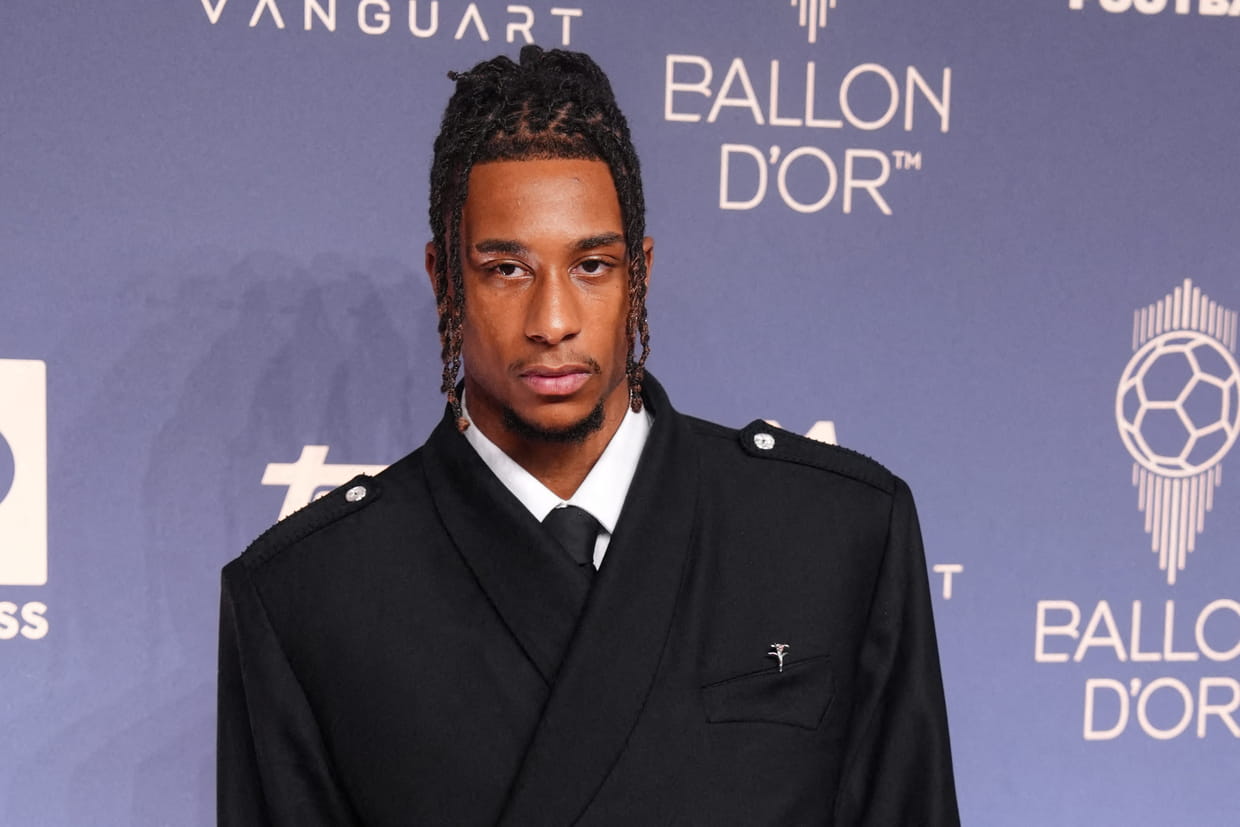
Michael Olise: The best player that was never going to win the 2026 Ballon d’Or

Michael Olise dazzled the world not just with record-breaking creativity but breathtaking brilliance and a season worthy of the Ballon d’Or, only to finish ninth while teammate Harry Kane claimed the crown. How?
Some footballers win matches. Others make football beautiful. But there was Michael Olise, who has spent the past year doing both, yet somehow, even with a season worthy of the highest individual honour, he was never the favourite to take home the Ballon d’Or.
Harry Kane has claimed the prize. And while the Bayern Munich striker has every reason to celebrate an extraordinary campaign, Michael Olise’s case deserves a much closer look.
Because when it comes to creativity, invention, technical brilliance and the ability to make spectators sit forward in their seats, few players can match what the Frenchman has offered. And at the highest level, he is able to replicate the magic.
From the Bundesliga to his historic FIFA World Cup campaign, many will not forget so soon how his individual moment crushed Real Madrid’s dream of reaching the Champions League semi-finals.
Only a few is capable of doing that, because that was the stuff of the best players. Deserving Ballon d’Or winners. The numbers are staggering. The football is even better.
Michael Olise: A creator without a rival
Start with the Bundesliga, where Olise was voted Player of the Season after scoring 15 goals and providing 19 assists. He finished as the league’s leading assist provider, proving that his influence extended far beyond the occasional moment of magic.
Then came the Champions League, where he scored five goals and registered six assists, earning a place in UEFA’s Team of the Season and finishing with joint most assists.
Olise was not merely making up the numbers among Europe’s elite. He was shaping games against them.
And when the World Cup arrived, the former Crystal Palace playmaker took his creativity to another level.
He delivered seven assists in eight appearances for France, surpassing Pelé’s longstanding record of six assists at a single World Cup. Five of those assists set up Kylian Mbappé, underlining the extraordinary understanding between the pair.
At the three major stages, he was a relentless creator. Olise’s ability to dictate games travelled with him from domestic football to Europe’s biggest club competition and the international stage.
His case was not built on reputation or a handful of spectacular nights. It was built on sustained excellence.
The art of making football look easy
Michael Olise is a nightmare for defenders because he rarely appears rushed. He can stand almost motionless, invite an opponent towards him, shift the ball with a subtle movement of his left foot and suddenly leave his marker chasing shadows.
His dribbling is not simply about speed. For Olise, it is about timing, balance, deception and knowing precisely when to accelerate. A shoulder drop and he already create the space he needs. A stepover and he sends a defender in the wrong direction. One perfectly weighted pass and he turns an ordinary attack into a goal-scoring opportunity.
And there is a certain audacity to his game. He does not always choose the obvious option, he sees passes others overlook and attempts things that demand both technical quality and supreme confidence.
That is what makes him such a joy to watch.
Olise does not merely beat opponents; he makes them look as though they have been given the wrong instructions.
Yet describing him as a creator alone would be selling him short. Fifteen Bundesliga goals and five in the Champions League demonstrate that he can finish attacks as well as create them. Across the season, he offered the rare combination of a prolific scorer and a relentless provider.
That was where Lamine Yamal was wrong when he claimed there was no other player as entertaining as him, because Michael Olise is. And depending on how people choose to see it, maybe the Frenchman was even better at it.
The numbers were never the whole story
The Ballon d’Or is often a contest between statistics, trophies, reputation and unforgettable moments. Michael Olise had a compelling argument in every category, but his strongest case was the breadth of his influence.
He could unlock a low block with a disguised pass, carry the ball through a crowded midfield, create an overload on the wing or finish an attack himself. He was equally comfortable operating as a traditional winger and drifting inside to dictate play.
His World Cup campaign was perhaps the clearest illustration of his value. Seven assists were not simply a remarkable statistical achievement; they were evidence of a player repeatedly making the decisive contribution for his country.
Breaking Pelé’s record gave his tournament an unmistakable place in football history.
Michael Olise also finished the campaign with 22 goals and 29 assists across all competitions for Bayern, an extraordinary tally for a player whose game is so heavily associated with creating chances for others.
The argument, then, is not that Kane had a poor season. Far from it.
His 73 goals for club and country made him a worthy winner, and his finishing was the defining feature of Bayern’s campaign.
But if the award is supposed to recognise the footballer who offered the most complete package, Michael Olise had every right to believe the prize should have been his. And to finish ninth is a mockery of the award itself.
Why Michael Olise Was Never Winning the 2026 Ballon d’Or
It is not that Michael Olise’s year wasn’t as good as anyone else’s; he was just a victim of uncomfortable circumstances at the national team, which then impacted his chances at Bayern Munich, and the Bavarians had to stick to their best shot.
Olise’s international teammates, Kylian Mbappé and Ousmane Dembélé, were also frontrunners for the award, with the former being the only main candidate from Real Madrid while the latter was the reigning champion.
It was always going to be difficult.
Obviously, it was his first time getting so close, and his PR was always going to come up short compared to players who have been used to the system.
At Bayern, there is no cause to say Kane was better. After all, Olise did win the Bundesliga Player of the Season award and was the best creator in the Champions League. At the World Cup, he also broke the record for the most assists whereas Kane’s impact faded in the knockouts.
Nevertheless, Bayern Munich chose to back the Englishman because he had better chances, being the face of his country alongside Jude Bellingham, who wasn’t one of the frontrunners.
That choice ultimately proved decisive, as Rodri’s chances affected Lamine Yamal in the voting pool, according to reports. And maybe, Michael Olise finding himself in ninth is why Harry Kane was able to claim the prize.
The kingmaker must decide what comes next
Instead, Michael Olise must settle for the role of kingmaker.
Harry Kane has the Ballon d’Or, the recognition and the defining individual honour of the season, while Olise has the satisfaction of knowing that few players made football as entertaining or as productive as he did.
There is an irony in that.
The man at the heart of so much of the ammunition for Bayern’s prolific striker has watched his teammate take the biggest individual prize.
Perhaps that is the nature of football. Goals are easier to count than the intelligence behind them because it is the final touch that attracts the headlines, while the pass that makes it possible can become a footnote.
But just as many others ahead him in the final Ballon d’Or ranking, Olise should not be reduced to that footnote. He was equally as good as any one, but even much better than several of those ahead of him in the pool.
At 24, he has already established himself among the world’s finest attacking players, and his next challenge will be turning another season of dazzling creativity into the sort of individual recognition that leaves no room for debate.
For now, Harry Kane is the king, but Olise is the man who helps make him one.
Whether that is a worthy consolation is a question only Olise can answer. But if the Ballon d’Or is meant to celebrate footballing brilliance in all its forms, his ninth-place finish in the final rankings feels like a remarkable underestimation of what he brought to the game.
The trophy belongs to Kane. The argument for Olise, however, is to be continued.