
Arsene Wenger’s daylight offside rule unlikely to endure after IFAB concerns

Arsène Wenger’s daylight offside proposal faces an uncertain future despite reportedly reducing offside decisions by 54 per cent and producing 13 additional goals across 112 Canadian Premier League matches.
Arsène Wenger’s proposal to overhaul football’s offside law faces an uncertain future after his controversial daylight rule reportedly failed to attract sufficient backing from assessment panels linked to the International Football Association Board (IFAB), despite encouraging early figures from its trial in the Canadian Premier League.
The trial has explored whether changing the offside threshold could reduce marginal decisions, encourage attacking football and make the game more entertaining.
However, the latest assessment suggests that positive statistical results may not be enough to convince football’s lawmakers that the proposed change should be extended.
How the proposed rule works
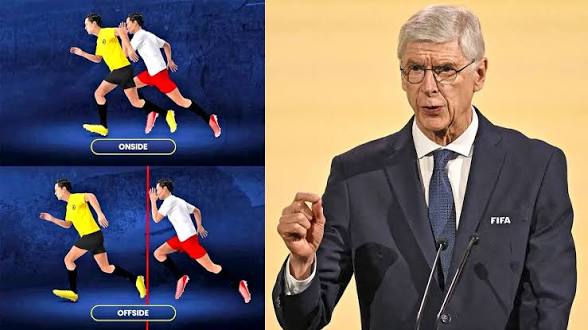
Under the existing law, an attacker can be ruled offside if any eligible part of their body is nearer to the opponents’ goal line than both the ball and the second-last opponent.
Arsene Wenger’s alternative requires a clear gap between the attacker and the second-last defender before an offside offence is given. An attacker would remain onside if any eligible part of their body were level with or behind the defender.
The former Arsenal manager, now FIFA’s chief of global football development, has long argued that the change could restore the advantage to attacking players and reduce controversy surrounding marginal offside calls.
Earlier, the Canadian Premier League became the first professional competition to test the alternative interpretation after adoption ahead of its ongoing 2026 season, in collaboration with FIFA.
Trial delivers a boost for attacking football
Across 112 Canadian Premier League matches, the trial reportedly produced a 54 per cent reduction in offside decisions and 13 additional goals, while defenders dropped approximately three metres deeper to avoid leaving attackers with space behind them.
Those figures suggest the revised interpretation has had a measurable influence on how teams approach matches.
Fewer offside calls could allow more attacking moves to continue, while the increase in goals may appeal to fans who want to see more open football.
However, the deeper defensive positioning also highlights a potential drawback. Rather than simply creating more attacking opportunities, the rule could force teams to abandon their usual defensive lines and alter established tactical approaches.
Concerns remain over the wider impact
The proposal has attracted criticism because of fears that it could give attackers too much of an advantage, placing additional pressure on defenders and goalkeepers.
There are also questions about whether changing the definition of offside would resolve the controversy surrounding video assistant referee decisions or simply move the threshold at which marginal calls are made.
Even with the current rule, technology has not eliminated debate over close decisions.
Wenger’s proposal would change the point at which an attacker becomes offside, but it would not necessarily remove the need for officials to make difficult judgements.
The Canadian experiment was designed to provide evidence from professional football rather than relying solely on theoretical arguments. Its findings will therefore be important in determining whether the potential benefits outweigh the tactical and practical concerns.
For now, the reported lack of support represents a setback for Wenger’s ambition to reshape one of football’s most fundamental laws, and whether the trial’s results can persuade lawmakers to reconsider the proposal remains uncertain.