Bordeaux’s historic downfall: Six-time French champions drop to sixth tier

Six-time French champions Bordeaux have fallen to France’s sixth tier following years of financial turmoil, with new owners Park Bench attempting to rebuild the club after the collapse of a proposed takeover, the loss of professional status and successive relegations.
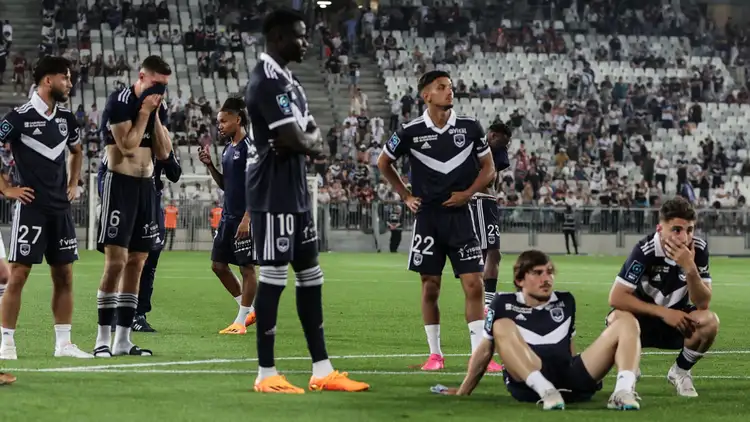
French football giants Girondins de Bordeaux have suffered another devastating blow after being relegated to the sixth tier, deepening a financial crisis that has transformed one of the country’s most successful clubs into a regional outfit.
The former Ligue 1 champions will compete in Regional 1 during the 2026–27 season after authorities approved their recovery budget, offering a pathway forward despite years of financial instability, mounting debts and successive relegations.
Bordeaux’s latest setback marks a remarkable fall for a club that won six French league titles, most recently in 2009, and helped develop several prominent players, including Zinedine Zidane, Bixente Lizarazu and Christophe Dugarry.
It has also served as home to several former Nigeria internationals like Kalu Uche, Samuel Kalu, and more recent Josh Maja.
The club’s immediate priority is now to establish financial stability and rebuild a competitive team capable of climbing back through the French football pyramid.
Financial crisis drives Bordeaux towards collapse
Bordeaux’s decline has unfolded over several years, with financial difficulties eventually threatening the club’s existence.
The situation became particularly serious in 2024 when a proposed takeover by Fenway Sports Group (FSG), the American investment company that owns Liverpool, collapsed.
Bordeaux had hoped the investment would provide the financial backing needed to avoid further sanctions. However, after negotiations broke down in July 2024, the club withdrew its appeal against an administrative relegation decision and accepted demotion to France’s National 1, the third tier.
The decision also triggered significant structural changes. Bordeaux renounced their professional status, which they had held since 1937, and terminated player contracts as part of efforts to reduce operating costs.
The club’s highly regarded training centre was also set to close, dealing a further blow to its reputation for developing young talent.
The loss of professional status represented a major turning point, leaving Bordeaux facing the challenge of rebuilding without the institutional and financial structures associated with professional football.
New ownership offers a potential lifeline
A change of ownership has since provided renewed hope after the recent acquisition by US-based investment group Park Bench for a symbolic €1 in September 2026, agreeing to assume responsibility for the club’s remaining debt.
The takeover came as the six-time champions continued to struggle with their financial obligations. They were subsequently sanctioned after failing to demonstrate the capacity to meet approximately €10 million in requirements for the 2025–26 and 2026–27 financial years, alongside outstanding debt payments.
Despite the difficulties, Bordeaux secured approval to compete in Regional 1 following a review by the Nouvelle-Aquitaine league’s oversight commission.
The club’s new president, Dominique Delport, welcomed the development, indicating that the approval would allow the rebuilding process to begin.
The proposed financial restructuring plan is expected to reduce Bordeaux’s debt from €26 million to €13 million, with repayment spread over 12 years. The new owners are due before a commercial court on October 20 to ratify the continuation plan.
Although the club will operate largely with amateur players, it can register up to five professionals. Former Ligue 1 striker Baptiste Guillaume is expected to be among those available.
From French champions to regional football
Bordeaux’s fall is particularly striking given their place in French football history.
The club won its most recent Ligue 1 title in 2009 and enjoyed considerable success in domestic and European competitions. Its 1995–96 UEFA Cup campaign ended in the final, with Zidane among the players who helped establish Bordeaux’s reputation on the continental stage.
Several former Bordeaux players also became key figures in France’s international success. Lizarazu and Dugarry joined Zidane in the squad that won the 1998 FIFA World Cup on home soil, while Alain Giresse and Jean Tigana were central figures in France’s 1984 European Championship triumph.
However, the club’s fortunes deteriorated after relegation from Ligue 1 in 2022, and judicial restructuring in 2024 accelerated the decline, stripping Bordeaux of their professional status and disrupting their academy operations.
Their subsequent descent into regional football highlights the scale of the damage caused by years of financial instability.
A long road back awaits Bordeaux
Bordeaux now face the difficult task of rebuilding their finances, restoring confidence among supporters and assembling a squad capable of competing for promotion.
Their new ownership provides an opportunity to stabilise the club, but a return to professional football will require sustained progress, disciplined spending and consistent results.
For a team that once competed for French titles and European honours, the immediate objective is considerably more modest: survival, recovery and gradual progress through the divisions.
Bordeaux’s history remains a source of pride, but restoring their former standing will depend on whether the latest rescue plan can succeed where previous efforts have failed.