How an unfriendly friendly that shouldn’t have happened left Burkina Faso at Argentina’s mercy

Argentina’s 7–0 win over Burkina Faso has been overshadowed by a chaotic travel dispute, financial disagreements and an emergency youth-heavy squad arriving just hours before facing the world champions.
Seven goals. Seven different scorers. Another emphatic night for Lionel Scaloni’s side at the Monumental.
But beneath the scoreline lies a story far more uncomfortable than the result suggests.
Because Burkina Faso did not arrive in Buenos Aires as the team that had originally been expected to face Argentina.
They arrived exhausted, heavily depleted and head into kickoff almost immediately after stepping off a long-haul flight.
And the controversy surrounding their journey has raised uncomfortable questions about money, logistics, player welfare and the way international friendlies involving less powerful football nations are organised.
This was supposed to be a football match. Instead, the match began with a storm.
Argentina was paying — But what kind of journey?
The first detail that makes the story particularly striking is that the travel and accommodation arrangements were being covered as part of the agreement for Burkina Faso to play Argentina.
But according to reporting by TN and journalist Romain Molina, the original arrangement involved low-cost commercial flights, rather than the comfortable direct charter that might ordinarily be expected for an international team travelling across continents.
The proposed itinerary could stretch to around 25 hours, involving commercial flights and a lengthy connection before reaching Argentina. For the Burkina Faso players, that was reportedly unacceptable.
They had just completed their AFCON qualifying commitments against Benin and Central African Republic, and were being asked to embark on another exhausting journey before facing the World Cup beaten finalists.
Several senior players reportedly refused to travel under those conditions. Then the dispute was no longer merely about getting from Africa to Argentina, it became a question of what the players were being asked to endure to make the friendly happen.
And there was another problem: The money
The travel dispute was reportedly accompanied by a disagreement over financial compensation.
According to Molina’s account, Burkina Faso were not receiving an appearance fee and would not receive a percentage of ticket sales or television revenue from the match.
La Gazzetta dello Sport similarly reported that the African side’s appearance fee was zero, with revenue from the fixture going to the Argentine federation and the agency involved in organising the games.
That meant the equation was difficult to ignore. Argentina had the global attraction, the television audience, and the commercial value.
And Burkina Faso had the invitation to play against the second best ranked team — but, according to those reports, no direct financial return from the spectacle.
For smaller football nations, the prestige of facing Argentina is enormous. But prestige does not shorten a 12-hour flight. And it does not pay a player’s bills.
The players’ rebellion in Casablanca
The situation eventually reached breaking point in Morocco. Burkina Faso’s delegation was in Casablanca after its AFCON qualifying match and was supposed to travel to Buenos Aires.
According to TN, some players packed their bags more than once, only to refuse to board under the proposed arrangements. The disagreement became serious enough for Burkina Faso’s sports minister to intervene personally at the team’s hotel.
Then came another twist.
The original aircraft scheduled to take the team to Argentina was cancelled after the operator reported a technical problem during checks.
Eurodata Sport, the company organising the match, said it immediately began searching for another aircraft. The organiser said some players subsequently decided not to travel because of the accumulated fatigue and logistical difficulties.
The explanations may differ in emphasis. But the consequence was the same. The original Burkina Faso team was falling apart.
A Charter. A Youth Team. A Race Against Time.
With senior players maintaining their refusal, Burkina Faso had to find another solution.
The federation turned to younger players.
An improvised squad, including 13 players without senior international caps, was assembled just to keep the friendly alive. Reports said the Under-23 players were brought in at short notice, while a new charter was arranged from Casablanca.
The last-minute charter was reportedly extremely expensive, with TN putting its estimated cost at close to $500,000.
So the irony became almost impossible to miss.A dispute that began partly over the quality and demands of the proposed travel arrangements eventually required an extraordinarily expensive emergency solution simply to get a Burkina Faso team to Buenos Aires.
And the clock was already against them.
Five hours before facing Argentina
When Burkina Faso finally landed in Buenos Aires, there was barely enough time to breathe. They arrived roughly five hours before kick-off due to the long journey from Africa, delayed departure, hastily assembled squad.
This ultimately meant little meaningful preparation and almost no recovery.
Then, waiting at the other end, were Argentina. A team that has just reached back to back World Cup finals.
The team packed with players accustomed to the biggest stages in football.
The circumstances were extraordinary before a ball was even kicked. EFE reported that the Burkina Faso team was due to arrive less than six hours before the match, with the disruption contributing to changes in the squad.
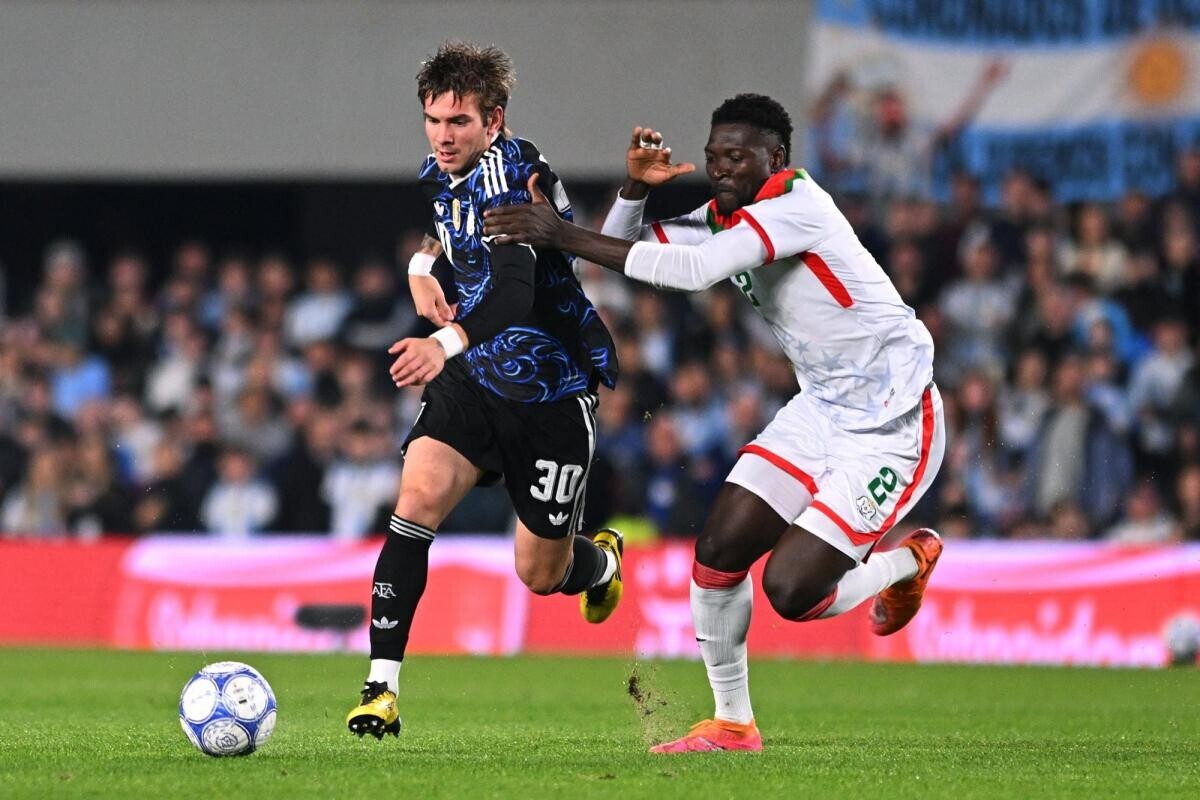
It was not an even starting line. Nine of the starting players were marking their international debuts, while they two others had barely started a game with the senior team.
Argentina showed no mercy
Once the referee blew the whistle, Argentina did what elite teams do when presented with weakness. They attacked it.
Lautaro Martínez opened the scoring after just three minutes, missing his penalty before converting the rebound. Five minutes later, Burkina Faso scored again — into their own net.
Gianluca Prestianni made it 3–0 after 12 minutes. Then came Nicolás Paz. Then Julián Álvarez. By the 36th minute, Argentina were five goals ahead.
The second half brought two more through Franco Mastantuono and Giuliano Simeone.
Seven goals without response. Seven different scorers. A footballing avalanche. But the result also created an uncomfortable question.
How much should a seven-goal victory tell us about the strength of Argentina when the opposition had been weakened so dramatically before kick-off?
Scaloni sympathizes with the Stallions
Interestingly, Argentina coach Lionel Scaloni appeared to understand the unusual circumstances.
Rather than treating the rout simply as another opportunity to celebrate Argentina’s superiority, he praised Burkina Faso for making the journey.
He acknowledged how difficult the circumstances had been and said the visitors could have stayed away, potentially forcing the match to be cancelled. For him, their decision to come was worthy of respect.
There was something revealing about that response. Argentina had just won 7–0, yet their own manager seemed conscious that the scoreline did not tell the entire story.
The organisers and their own version
Eurodata Sport, the company responsible for organising the match, said the original flight was cancelled because of a technical issue discovered during aircraft checks.
Its CEO and FIFA agent Jairo Pachón said an alternative aircraft was sought immediately and that some players subsequently refused to travel because of accumulated fatigue.
The organiser also said replacements had to be brought in from Burkina Faso to join the remaining delegation in Casablanca.
It was also reported that the Burkina Faso federation and government attempted to persuade the dissenting players to reconsider, but ultimately accepted their decision and proceeded with replacements and a new charter.
So there are competing accounts of how the crisis unfolded, but there is no real dispute about the most extraordinary part.
Burkina Faso arrived just hours before facing Argentina. The scoreline of 7-0 will survive, and so will the questions. But the record book will not show the players who refused to travel.
It will not show the proposed low-cost itinerary.
It will not show the arguments over compensation.
It will not show the minister walking into the hotel.
It will not show the last-minute charter.
It will not show the emergency Under-23 call-ups.
And it certainly will not show the exhausted faces of players who had travelled thousands of miles before walking into the Monumental.
That is why this 7–0 victory deserves more than a footballing headline.
Argentina were brilliant. Burkina Faso were overwhelmed. But somewhere between the first flight plan and the final whistle, the friendly itself became the story.
Seven goals were scored in Buenos Aires, but the biggest questions were never about the goals.
They were about who paid, who profited, who travelled, who refused, and how a supposedly friendly football match became an international scramble just to get one team onto the pitch.