
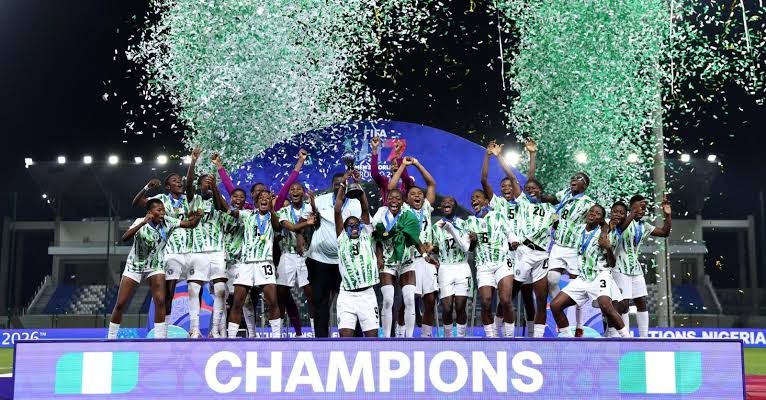
How Busari’s Babes conquered the world and secured Africa’s first U-17 Women’s trophy

Nigeria’s Flamingos made history by becoming the first African nation to win the FIFA U-17 Women’s World Cup, securing a landmark 2-1 victory over Japan in the final in Morocco.
For years, Africa had produced the talent, the passion and the occasional giant-killing performance at the FIFA U-17 Women’s World Cup, but the continent had never managed to take the ultimate step.
There had been promising campaigns, celebrated individual performances and moments that suggested an African nation could compete with the world’s best.
Yet, whenever the tournament reached its decisive stages, the trophy remained beyond the continent’s reach.
Nigeria had come closest to changing that narrative. The Flamingos finished third in 2022, their previous best performance, after suffering a heartbreaking penalty shootout defeat to Colombia in the semi-finals, while other African representatives also struggled to turn their participation into a genuine championship challenge.
The continent had watched as Asian and European nations took turns celebrating, with Africa left to wonder when its own moment would arrive.It was a particularly frustrating reality considering Africa’s enormous contribution to women’s football.
From Nigeria’s established pedigree to the emergence of Ghana, Cameroon and other nations, the continent had never lacked promising young footballers.
But on November 7, 2026, in Rabat, Morocco, Hakeem Busari and his fearless Flamingos finally ended that wait, putting not only Nigeria but the whole of Africa on the map.
A 2-1 victory over Japan in the final delivered Nigeria’s first FIFA U-17 Women’s World Cup title and made the country the first African nation to win the competition.
It was not just a national triumph; it was also a historic breakthrough for an entire continent.
The achievement carried another significant distinction, as it was Nigeria’s first appearance in a FIFA competition final across its men’s and women’s national teams since the Golden Eaglets defeated Mali to win the men’s U-17 World Cup in 2015.
Eleven years later, another generation of Nigerian youngsters had taken the country back to the summit, this time through the women’s game. Here is how they managed to achieve it, from a losing start to a triumphant finish.
The group stage: A painful start, followed by a statement of intent
Nigeria’s campaign began with a 2-1 defeat to Poland, exposing defensive weaknesses and leaving little room for error.
Busari’s girls, however, responded with a 2-0 victory over Puerto Rico, courtesy of Oluwakemi Adegbuyi and substitute Precious Oscar.
Nevertheless, it was their performance against defending champions North Korea that proved decisive. Goals from Adegbuyi, Oluebube Umejiaku and Kanyinsola Yusuf inspired a remarkable 3-1 victory, booking Nigeria’s place in the knockout rounds with six points.
Round of 16: Mexico bow to Nigerian resilience
Mexico presented a difficult test, but the Flamingos responded with authority. Umejiaku produced an outstanding individual effort in the 40th minute, weaving through three defenders before finishing to give Nigeria the lead.
Mary Dunstan doubled the advantage in the 71st minute with a powerful finish, ensuring that Emily Delgado’s stoppage-time strike for the North American side proved only a consolation as the girls held on for a place in the last eight.
Quarter-final: Oduntan delivers when it matters
Venezuela had eliminated Germany in the previous round and threatened to end Nigeria’s ambitions. The South Americans defended stubbornly, with goalkeeper Valeria Rebanales frustrating the Flamingos’ attackers.
Just when the contest appeared destined for penalties, Oluebube Umejiaku won a late spot-kick, and captain Azeezat Oduntan stepped up to convert in the 89th minute, securing a dramatic victory and sending Nigeria into the semi-finals for the second time in their history.
Semi-final: Brazil thrashed as Flamingos reach uncharted territory
Brazil became Nigeria’s next victim in a commanding 3-1 victory that secured the country’s first-ever final appearance at the tournament.
After a goalless first half, Queen Joseph broke the deadlock in the 56th minute, finishing after Oluwakemi Adegbuyi’s effort was saved.
Awawu Bashiru then stole the show, scoring in the 71st and 80th minutes to take the game beyond Brazil. Her outstanding display earned her the Player of the Match award, while Greise Kelly grabbed a consolation goal for the South Americans.
Final: Japan and the world conquered for history
Japan, a former champion appearing in its fourth final, stood between Nigeria and immortality.
The Flamingos started brightly and were rewarded in the 39th minute when Awawu Bashiru’s long-range effort slipped through goalkeeper Kou Kadowaki’s hands.
Two minutes after the restart, Umejiaku produced a delightful lob over the advancing goalkeeper following Esther Stephen’s pass, sending the Flamingos closer to their dream.
Fuki Ito reduced the deficit in the 80th minute, but Nigeria survived Japan’s late pressure to secure a memorable 2-1 victory.
A victory bigger than a trophy
The significance of this triumph stretches far beyond the medals and celebrations in Rabat.
Africa had previously celebrated Ghana’s third-place finish in 2012 and Nigeria’s bronze medal in 2022, but neither achievement could compare with becoming world champions.
The Flamingos have now given the continent its first U-17 Women’s World Cup title and demonstrated that African football can produce teams capable of going all the way.
For Busari, his technical crew and the players, this is the reward for a remarkable campaign built on resilience and collective belief.
Nigeria did not simply win because of individual brilliance; they demonstrated an ability to respond to setbacks, adapt to different opponents and deliver when the pressure was greatest.
However, perhaps the most important chapter of this story begins after the celebrations. Nigeria must ensure that this generation does not become another collection of promising youngsters whose potential is celebrated before being neglected.
The Nigeria Football Federation, government authorities, clubs and other stakeholders must create a proper development pathway for these players.
Ensuring they secure moves to suitable clubs with quality coaching, educational support and opportunities to progress into senior football must become priorities.
The Flamingos have conquered the world, but their greatest contribution to Nigerian football could still lie ahead, especially in an era when the Super Falcons’ continental dominance is already in question.
The challenge is to nurture these talents, protect their development and ensure that Morocco 2026 becomes the beginning of a successful generation rather than a beautiful memory of what might have been.
Africa waited 18 years for this moment since the inaugural FIFA U-17 Women’s World Cup was held in 2008. Nigeria’s Busari babes have finally delivered it.